
How to Tell if Silver Is Real: 7 At-Home Tests
Table of Contents
- The 925 Stamp and Other Marks That Prove Authenticity
- Magnet, Ice, and Ping Tests: Quick At-Home Checks
- Sterling Silver Hallmarks Guide: Reading Purity Marks
- Silver vs Silver Plated Differences: Base Metal vs Precious Metal
- Weight and Density Verification Using a Digital Scale
- How to Clean Sterling Silver Jewelry Without Damaging It
- Non-Destructive Testing for Vintage Jewelry
- Conclusion
- Frequently Asked Questions
Last Updated: September 25, 2026
The 925 Stamp and Other Marks That Prove Authenticity
The fastest way to tell if silver is real is to find a stamp. Genuine sterling silver carries a "925" mark, meaning it is 92.5% pure silver. Most real pieces also show a maker's mark or country mark nearby.
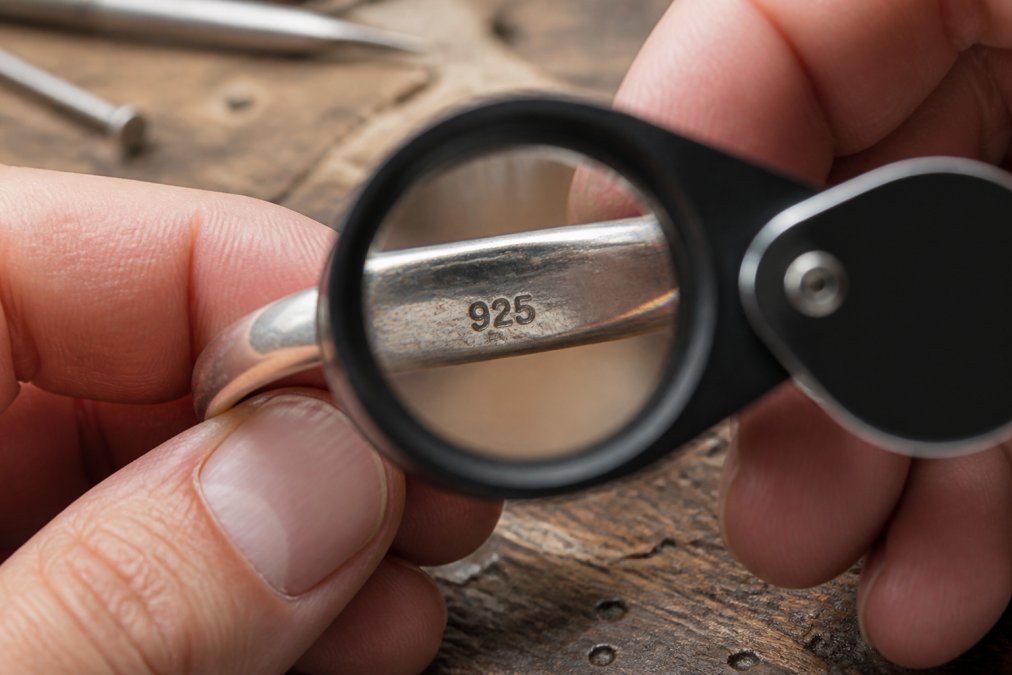
Look for these marks:
- 925 or Sterling on rings, chains, and pendants
- 999 Fine on bullion and coins
- A maker's mark, like a small symbol or initials
- A country or assay office mark
Common Fake Markings to Avoid
Some stamps are red flags. Watch for "silver plated," "EPNS," "German silver," and "nickel silver." None of these contain real silver.
Magnet, Ice, and Ping Tests: Quick At-Home Checks
Three quick tests can help you tell if silver is real without any tools. Silver is non-magnetic, conducts heat fast, and rings with a clear tone. Each test takes seconds.
The Magnet Test for Silver
Silver is not magnetic. A strong magnet should slide off with no pull.
The Ice Cube Test and Thermal Conductivity
Silver moves heat faster than almost any metal. Place an ice cube on the surface. Real silver makes it melt quickly, and the metal feels cold to the touch right away.
Sterling Silver Hallmarks Guide: Reading Purity Marks
A hallmark is a stamp applied by the maker or an assay office to declare a metal's purity. On real sterling, the mark is struck into the metal with a punch, so it sits in a shallow depression with slightly raised edges. On fakes, the mark is often cast in, laser-etched, or stamped so lightly it barely breaks the surface.
Here is what each common mark means:
| Mark | Meaning | Common On |
|---|---|---|
| 925 | 92.5% silver | Jewelry, flatware |
| 999 or Fine Silver | 99.9% silver | Bullion, coins |
| Sterling | Same as 925 | Rings, chains, flatware |
| STER | Abbreviation for sterling | Older flatware |
| Coin | 90% silver (pre-1965 U.S. coins) | Dimes, quarters, half dollars |
| EPNS | Electroplated nickel silver, no solid silver | Cheap flatware |
| EP | Electroplated | Plated holloware |
| German silver | Copper-nickel-zinc alloy, no silver at all | Costume jewelry |
| Nickel silver | Same as German silver, no silver | Costume jewelry |
| Silver-tone | Color only, no silver content | Fashion jewelry |
| Silver plated | Thin silver layer over base metal | Flatware, serving pieces |
Common Fake Markings to Avoid
Some stamps are designed to sound like silver without being silver. Watch for these red flags:
- EPNS, EP, EPBM, electroplated, no solid silver
- German silver, nickel silver, alloys that contain zero silver
- Silver-tone, silver-colored, silver look, color descriptors only
- Alpaca, Alpacca, a nickel-silver alloy used in some imported flatware
- A lone "925" on a piece that also shows a copper or brass edge, the stamp may be on a plated shell
Reading Worn or Partial Hallmarks
Vintage silver often has faded, rubbed, or partially worn stamps. A missing or faint mark does not automatically mean fake. Look for:
- Remnants of a punch, even a worn stamp usually leaves a slight depression
- A maker's mark nearby, many pieces carry both a purity mark and a maker's symbol
- Consistency across the piece, real flatware usually has matching marks on every major component
Silver vs Silver Plated Differences: Base Metal vs Precious Metal
Solid sterling silver is silver all the way through. Silver plate is a thin layer of silver over copper, brass, or another base metal. This is the single biggest difference to understand.
Visual Inspection for Wear Patterns and Patina
Look closely at the surface. Real silver wears evenly and develops a soft patina over time. Plated pieces show a different pattern.
Check these spots:
- High points on rings and clasps, where plating rubs off first
- Edges where a different color metal peeks through
- Deep crevices, where real silver darkens with oxidation
Weight and Density Verification Using a Digital Scale
Silver is dense, about 10.49 grams per cubic centimeter at room temperature. That number is the backbone of the most reliable at-home test for coins, bars, and solid jewelry, and it is the one most guides skip because it takes a few minutes and a kitchen scale. Here is the full procedure.
What You Need
- A digital scale accurate to 0.01 grams (a jeweler's scale or a good kitchen scale)
- A cup or container wide enough to fully submerge the item
- Distilled or filtered water (tap water works, but minerals add slight error)
- A thin piece of thread or fishing line to suspend the item
Step-by-Step Density Calculation
- Weigh the item dry. Record the weight in grams. Call this W1.
- Fill the container with enough water to fully cover the item, and set it on the scale. Tare the scale to zero.
- Suspend the item by the thread and lower it into the water so it is fully submerged but not touching the bottom or sides.
- Record the new weight. This is the buoyant weight, or W2. The difference (W1 − W2) equals the weight of the water displaced.
- Divide W1 by (W1 − W2). The result is the item's specific gravity.
What the Number Means
| Metal | Specific Gravity |
|---|---|
| Fine silver (999) | ~10.49 |
| Sterling silver (925) | ~10.36 |
| Copper | ~8.96 |
| Brass | ~8.5 |
| Nickel silver | ~8.7 |
| Lead | ~11.34 |
| Steel | ~7.8 |
A reading between roughly 10.2 and 10.5 points to sterling or fine silver. A reading near 8.5 to 9.0 points to copper, brass, or nickel silver, meaning the piece is plated or fake. A reading near 11.3 is a warning sign for lead, which some counterfeit bars use to fake weight.
Trade-Offs and Limits
- Best for solid pieces. Coins, bars, and thick rings give clean readings. Thin chains, hollow beads, and pieces with stones or air pockets trap air and skew the result low.
- Air bubbles ruin the test. Tap the item gently or add a drop of dish soap to break surface tension before submerging.
- Plated pieces can pass. A thick silver plate over a copper core may land close to sterling on a small item. Density confirms the average, not the surface.
- Combine with other checks. Use density alongside the magnet, ice, and hallmark tests, no single test is conclusive.
For background on how metals are characterized by density and purity, the Britannica entry on silver and its properties is a useful reference.
How to Clean Sterling Silver Jewelry Without Damaging It
Cleaning sterling silver jewelry the wrong way strips its finish. The safe method is gentle and uses items you already have.
Try this:
- Mix warm water with a few drops of mild dish soap
- Soak the piece for a few minutes
- Rub softly with a soft cloth, not a brush
- Rinse and dry completely
Non-Destructive Testing for Vintage Jewelry
Vintage pieces need extra care. You cannot scratch or acid-test them without hurting their value. Non-destructive testing lets you check authenticity without leaving a mark.
Use these safe methods:
- Visual inspection under a loupe for hallmarks and wear
- Magnet test to rule out ferrous base metals
- Density check with a scale and water
- Ping test on coins and solid pieces for a clear ring
Conclusion
Telling real silver from a fake comes down to patience and a few simple checks. Stamps, magnets, ice, density, and a careful eye will catch most fakes. But the surest sign of quality is how a piece is made and who made it.
Frequently Asked Questions
How do you test silver at home?
Start with a magnet: real silver is non-magnetic, so if a magnet sticks, the piece contains ferrous base metal like steel or nickel. Next, place an ice cube on the metal. Silver has high thermal conductivity, so ice melts almost immediately. Check for a 925 stamp or 999 fine mark with a jeweler's loupe. For a more precise result, weigh the piece on a digital scale and calculate its density against the expected specific gravity of sterling silver, which is about 10.3.
Does a magnet stick to real silver?
No. Real silver, including sterling silver and 999 fine bullion, is non-magnetic. A magnet will not stick to it. If a magnet does stick, the piece is likely made of or contains a ferrous base metal such as steel or iron. Keep in mind that some counterfeit pieces use non-magnetic base metals like copper or brass, so a magnet test alone cannot confirm authenticity. Use it alongside a hallmark check and a density calculation for a more reliable answer.
What does the 925 stamp mean on jewelry?
The 925 stamp indicates sterling silver, which is 92.5% pure silver mixed with 7.5% copper or another metal for strength. It is the most common purity mark on silver jewelry in the United States. You may also see 999 fine for bullion-grade silver or 800 for a lower-purity alloy used in some vintage pieces. A 925 stamp is a strong indicator of authenticity, but counterfeiters do sometimes stamp base metal with 925, so confirm with a density test or a professional assay.
Can real silver be unmarked?
Yes, real silver can be unmarked. Vintage jewelry, handmade pieces, and items from certain regions may never have received a hallmark, or the mark may have worn away from years of polishing and wear. If a piece is unmarked, rely on other tests. Check for tarnish and oxidation patterns, verify the weight and density on a digital scale, and try the ice cube test. For valuable or vintage items, a professional assay or X-ray fluorescence test gives a definitive answer without damaging the piece.